
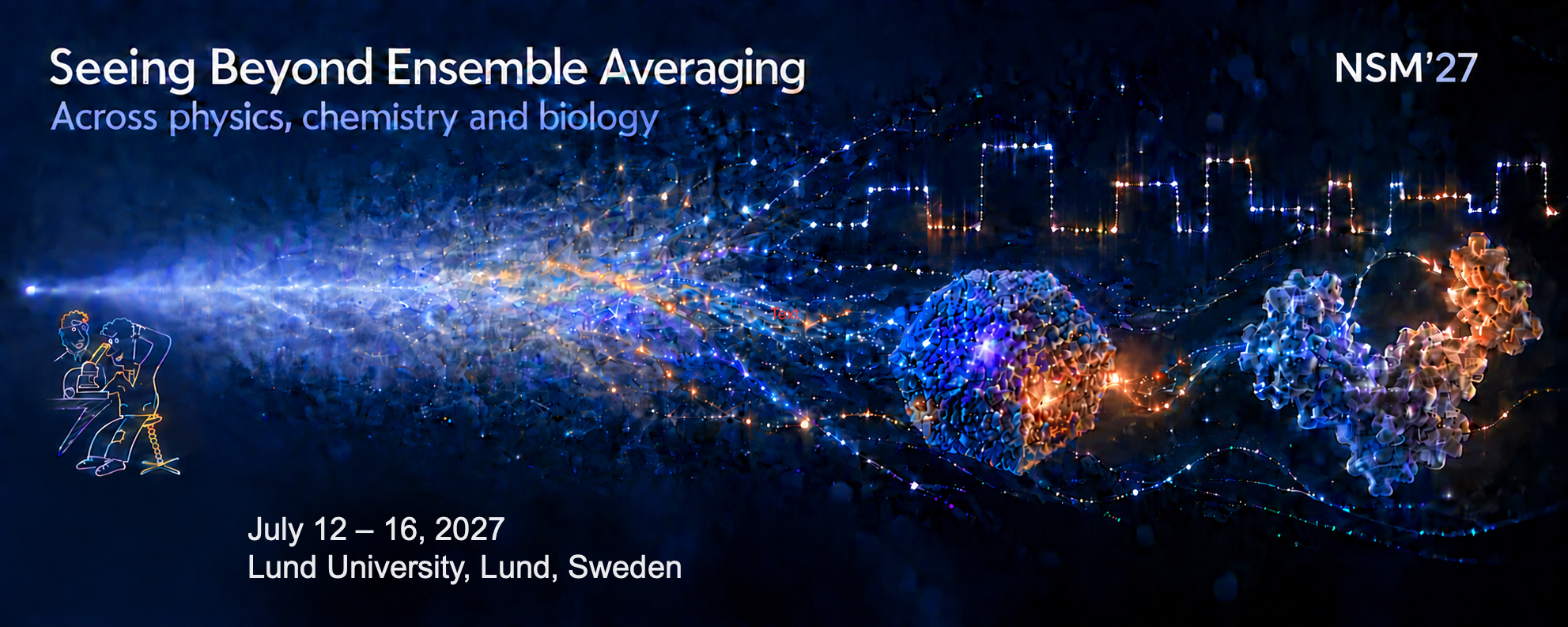
Welcome to NSM 2027, Nanoscale, Single-Molecule and Related Spectroscopies (NSM’27) Conference, taking place in Lund July 12–16, 2027.
Historical and scientific background of the conference
The Nanoscale, Single-Molecule and Related Spectroscopies (NSM) conference is a leading international forum dedicated to research at the intersection of single-molecule science, nanoscale spectroscopy, nanomaterials, and quantum optical phenomena.
The conference series has a long history starting from 1987. It originates from meetings on high-resolution optical spectroscopy and spectral hole burning – methods which in the end 1980-s allowed scientists to probe molecular properties beyond ensemble averaging. Up to now there have been 15 conferences taking place all over the world: 1987 (Tallin, USSR), 1991 (Monterey, USA), 1992 (Ascona, Switzerland), 1994 (Tokyo, Japan), 1996 (Brainerd, USA), 1999 (Hourting, France), 2001 (Taipei, Taiwan), 2003 (Bozeman, USA), 2006 (Aussois, France), 2009 (Palm Cove, Australia), 2012 (Tubingen, Germany), 2015 (Tartu, Estonia), 2018 (Suzdal, Russia), 2022 (Bayreuth, Germany), 2025 (Sapporo, Japan).
Website of the last NSM’25 in Japan can be found here: https://nsm2025.org/index.html
Go beyond ensemble averaging is the central concept of the conference from its origin to today.
Later in 1990-s with emerging of classical single molecule spectroscopy based on fluorescence the conference changed its name to Hole Burning, Single Molecule Spectroscopy and related spectroscopies (HBSM). In 2025 the name was changed to NSM (Nanoscale, Single-Molecule and Related Spectroscopies) to reflect the expanding scientific scope and the growing global interest in nanoscale and quantum-enabled approaches.
Today, nanomaterials, nanostructures, and quantum phenomena are central to advances in energy technologies, photonics, catalysis, sensing, information processing, and biological imaging. Understanding how individual molecules, defects, or nanoscale objects behave — rather than their ensemble-averaged response — has become a defining challenge in modern science. NSM addresses this challenge directly by focusing on experimental and theoretical methods that provide spectral, spatial, temporal, and polarization resolution at the level of single nano-objects and local regions in materials beyond ensemble averaging. By seeing beyond ensemble averaging, scientists gain access to intrinsic variability, transient dynamics, and quantum effects that are otherwise hidden, enabling deeper insight and control of physical, chemical, and biological systems.
A defining characteristic of NSM’27 conference is its intrinsically multidisciplinary nature. The conference brings together researchers from physics, materials science, chemistry and biology, united by a common goal: to observe, understand, and control nature beyond ensemble averaging using optical methods.
Non-exclusive list of topics:
- Single-molecule spectroscopy and imaging
- Time-resolved spectroscopic techniques combined with microscopy
- Properties of materials and nanostructures beyond ensemble averaging
- Optical spectroscopy with high spatial resolution
- Quantum emitters, defects, color centers, and excitonic phenomena
- Single photons for technology
- Nano-optics, plasmonics, and photonic structures
- Super-resolution fluorescence microscopy
- Single molecule studies of biological and soft-matter systems
Important dates
- 31 January – Abstract submission oral closes
- 31 April – Abstract submission poster closes
- 31 March – Registration opens
- 01 April – Early bird ends
- 12 May – Regular registration closes
- 12 June – Registration closes
See the full timeline of the conference here.


Confirmed speakers (invited and reqular)
Thomas Basché, University of Mainz, Germany
Arindam Chowdhury, IIT Mumbai, India
Richard Hildner, University of Groningen, Netherlands
James Hutchinson, University of Melbourne, Australia
Fedor Jelezko, University of Ulm, Germany
Jürgen Köhler, University of Bayreuth, Germany
Masaru Kuno, University of Notre Dame, USA
Jean-Sébastien Lauret, Université Paris Saclay, France
Peter Lu Bowling Green State University, USA
Yu-Jung Lu, Center for Applied Sciences Academia Sinica, Taiwan
Andrey V. Naumov, Lebedev Physical Institute RAS, Russia
Vahid Sandoghdar, Max Planck Institute for the Science of Light, Germany
Ivan Scheblykin, Lund University, Sweden
Gabriela S. Schlau-Cohen, Massachusetts Institute of Technology, USA
Costanza Toninelli, European Laboratory for Non-Linear Spectroscopy, Italy
Hiroshi Ujii, Hokkaido University, Japan
Martin Vacha, Institute of Science Tokyo, Japan
Libai Huang Purdue University, USA
Carole Diederichs, Sorbonne University, France
Ana Predojevic, Stockholm University, Sweden
Madhavi Krishnan (UK), University of Oxford, UK
Jana Nieder Iberian Nanotechnology Laboratory, Portugal
Johan Hofkens, KU Leuven, Belgium
Yuxi Tian, Nanjing University, China
Archana Raja, Lawrence Berkeley National Laboratory, USA
Alberto G. Curto, Ghent University and IMEC, Belgium
Rafi Budakian, University of Waterloo, Canada
Etienne Gaufrès, CNRS, France
Gordon Hedley, University of Glasgow, UK
Sponsored by

The conference starts in
Day(s)
:
Hour(s)
:
Minute(s)
:
Second(s)
Contact
For questions concerning the conference, please contact ivan.scheblykin@chem.lu.seu.se
Important dates
- 31 January - Abstract submission oral closes
- 31 April - Abstract submission poster closes
- 31 March - Registration opens
- 01 April - Early bird ends
- 12 May - Regular registration closes
- 12 June - Registration closes